
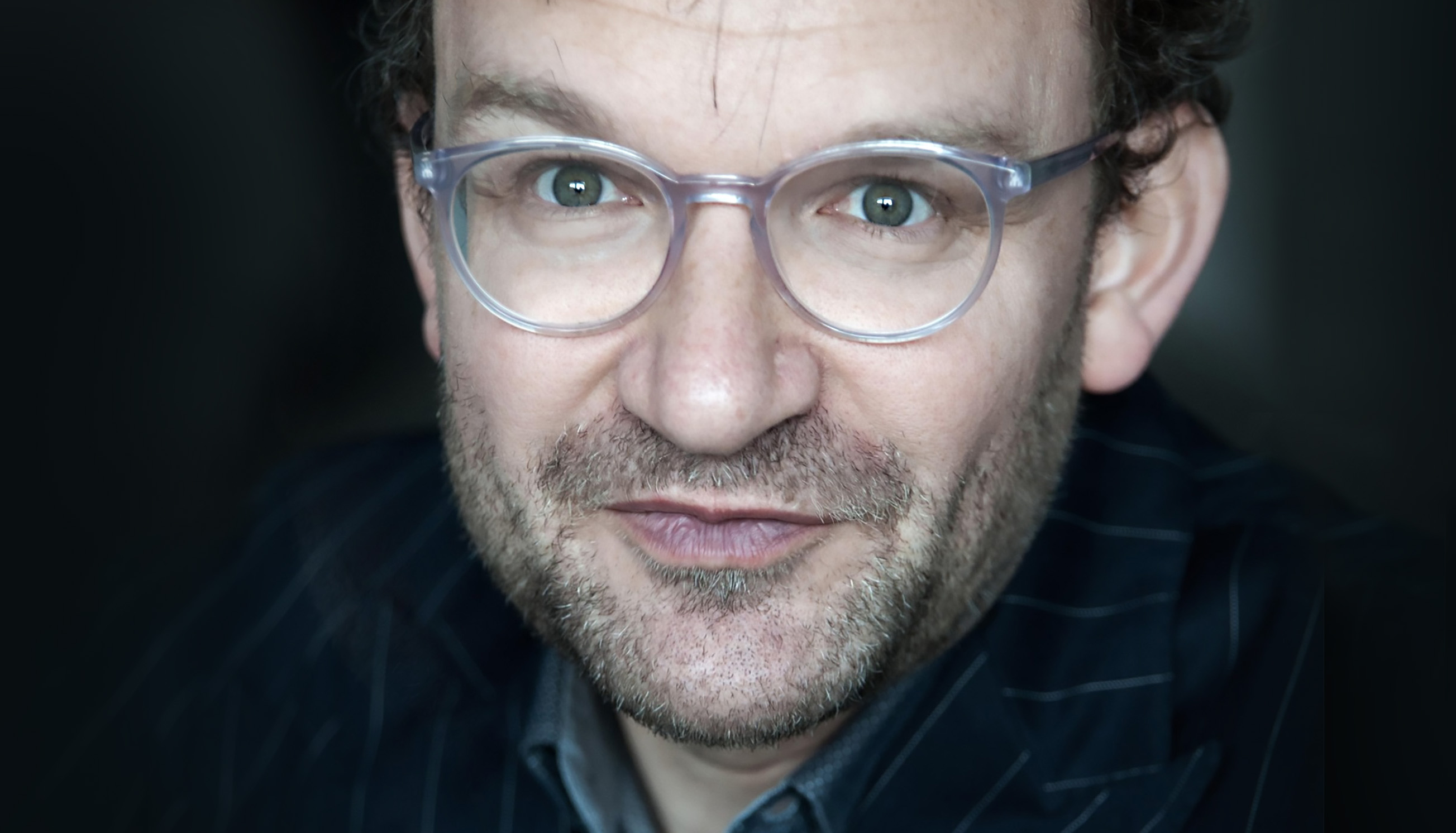
Swiss composer and organist Michael Pelzel presents his new violin concerto «Carnatic Pandora» – a commissioned work by the ACHT BRÜCKEN Festival Cologne and the Basel Sinfonietta, supported by the Ernst von Siemens Music Foundation, Swiss Arts Council Pro Helvetia and the SUISA Foundation.
We look forward to our renewed collaboration with Michael Pelzel at the guest performance on May 5th at the Cologne Philharmonic Hall and on May 7th as part of the 5th subscription concert at the Basel City Casino.
Michael Pelzel is one of the most exciting contemporary Swiss composers. His compositions are performed all over the world. In recent years, he has undertaken several trips to India. During these study visits, he immersed himself in the classical Carnatic music of South India. This eccentric, richly ornamented music has profoundly influenced the composer—and inspired his new violin concerto, "Carnatic Pandora."
In addition to his work as a freelance composer, he is the organist of the Reformed Church of Stäfa on Lake Zurich.
To get to know him better, we asked him a few questions.
Was there a musical "awakening experience" in your life? If so, what was it?
There wasn't really one specific experience that stood out, except that I was extremely impressed by the church organ at an Easter service. The organist played the Toccata from Charles-Marie Widor's Fifth Organ Symphony, and after that I absolutely wanted to learn to play the organ. I was often very emotionally moved by musical experiences because I sang in several choirs, and that's probably where my passion for music was ignited.
Are there any pieces that have particularly influenced you?
I am a big fan of the music of Max Reger and Olivier Messiaen. These two composers have had a very lasting influence on me, as has the French composer Gérard Grisey.
During several trips to India, you explored non-European musical traditions and playing techniques, such as the classical Carnatic music of South India. How do these experiences inform your violin concerto "Carnatic Pandora"?
During several stays in India in 2016, 2017, and 2018, I had the opportunity to live and work in various cities, including Varanasi, Chennai, Kolkata, and Mumbai, and to take music lessons in Carnatic (South Indian) music. I was particularly fascinated by the elastic and highly ornamented nature of the melodic structure, especially when listening to the veena and violin.
Also influenced by Indian music is my preference for sustained sounds and drones, which are primarily played by the tanbura or a type of mini-accordion.
What fascinates you about traveling (outside of music)?
I am personally always fascinated by encounters with people from completely different cultures, such as the indigenous people of Tierra del Fuego or musicians in South India or Africa. This exchange through conversation about different cultures and traditions has always been very enriching for me. Ultimately, one learns that we are all human beings with fundamental needs and desires that transcend cultural boundaries.
How can contemporary music help stimulate the exchange between different cultures?
That's a very difficult question, whether that's even possible. Two years ago, I traveled to Namibia and was able to make contact with several choirs there. I would like to delve deeper into their music, culture, and traditions, and also compose music for these choirs. Perhaps, in doing so, they might also learn something about my or our European culture. In my opinion, such projects also create a very enriching cultural exchange, as we try to understand each other's musical language.