On March 3rd, at our third subscription concert in the Burghof Lörrach, we will present "#Metoo, Hitchcock," the world premiere of a new film score by Moritz Eggert for Alfred Hitchcock's silent film classic "Blackmail."
We are very much looking forward to this collaboration and the new work!
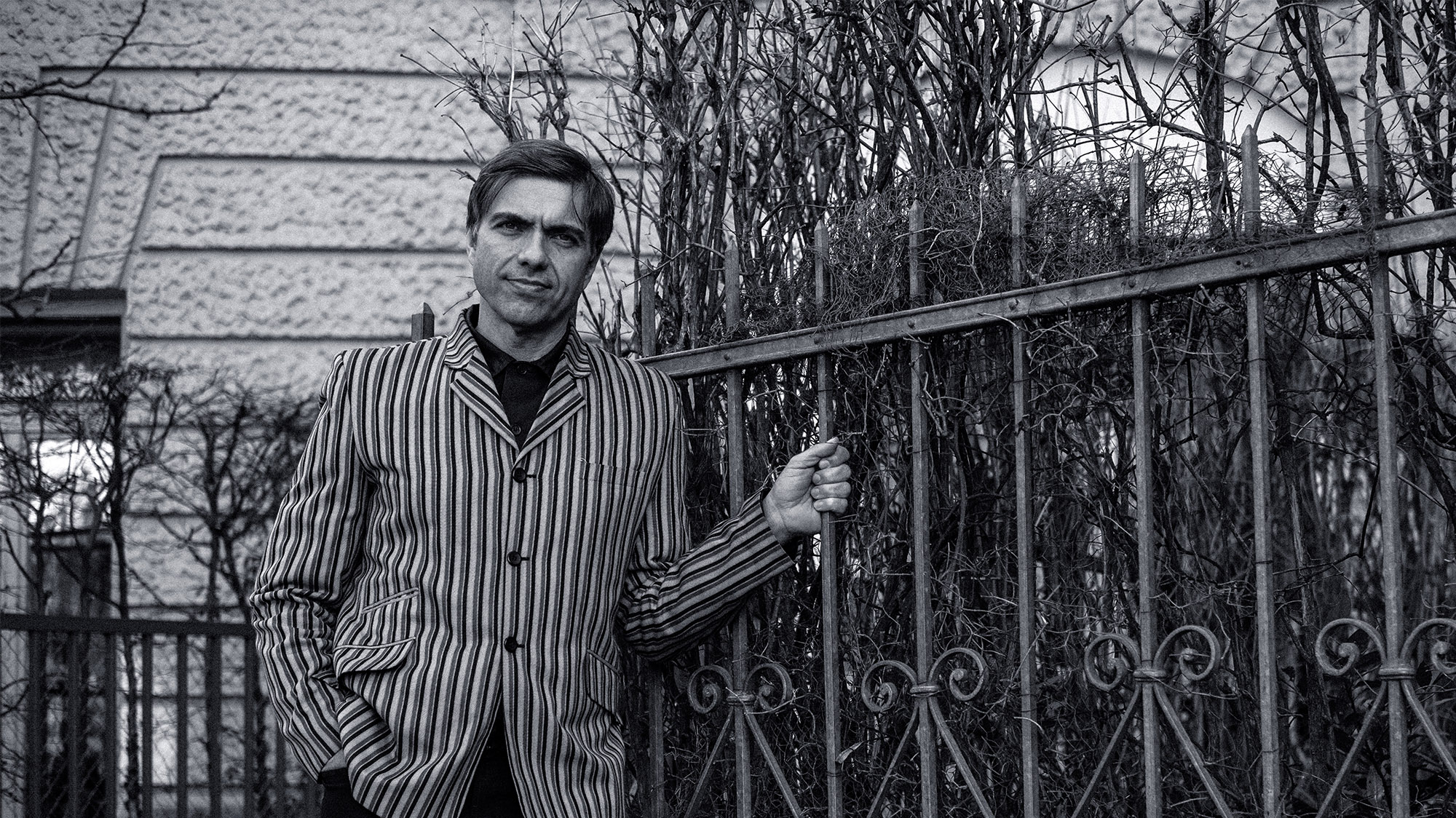
Moritz Eggert was born in Heidelberg in 1965. After studies in Frankfurt, Munich, and London, he steadily expanded his compositional output, focusing on music theater (19 operas to date), vocal and instrumental music, as well as conceptual and performative works. His work often explores extremes in the intensification of aspects of musical material. Contrary to the typical image of "serious" academic music, his art frequently employs irony, parody, or satire to captivate the audience, but he also doesn't shy away from emotionality or melody when necessary. As a blogger ("Bad Blog of Musick") and author, he is a well-known critical voice in contemporary music.
To get to know him and his interest in Hitchcock's "Blackmail" better, we asked him a few questions:
1. How did you first come into contact with "classical music" and why have you been unable to let go of it?
My mother had an eclectic taste in music, and there was always music playing in our apartment, with no distinction made between John Dowland and the Rolling Stones. In that sense, music was generally an important part of my youth. I discovered very early on that I could imagine music in detail in my head – on long car journeys, I would press my ear against the window and be able to listen to any music I wanted in the white noise; this was long before smartphones and MP3s.
One of my first records, Sviatoslav Richter's "Pictures at an Exhibition," specifically introduced me to classical music.
2. Are there any pieces or experiences that have particularly influenced your development as a composer?
Two names have been particularly important to me in exploring the field of "New Music," and those are Erik Satie and Charles Ives. I've always had a soft spot for musically unconventional and outsider composers, and both remain very important to me in terms of their thinking and aesthetics, even though their music could hardly be more different. What unites them, however, is their unconditional will to freedom and independence—I could never relate to stylistic dogmatism or academic self-indulgence.
3. You describe yourself as the "Bad Boy of New Music." What's the story behind that, and what's your mission as a Bad Boy?
The real "Bad Boy of Music" is, of course, George Antheil. I can't compete with that, as I haven't yet brought any firearms to a concert to intimidate a rebellious audience. I don't call myself that either, but I did have a column in the NMZ under that pseudonym, which later became the "Bad Blog of Musick," which still exists today. "Bad" in this context doesn't mean "evil," but rather "naughty," and a bit of wildness and naughtiness is certainly something the avant-garde, which has become rather bourgeois and complacent in recent decades, could use. Above all, though, I was interested in the element of humor, and that's why it's part of our blog to look at certain aspects of the scene with humor—something that's definitely often missing.
4. Hitchcock's "Blackmail" was released in 1929, you were born in 1965. What interests you about his films and about film music in general?
I originally wanted to be a film director, not a composer, and Hitchcock has certainly been one of my greatest idols since my earliest youth. I know all his films and have studied them intensively. His most important film composer – Bernhard Herrmann – is an absolute idol of mine and has certainly influenced my music greatly (which you can definitely hear in my score for "Blackmail" as a homage). Therefore, it was a no-brainer for me to immediately say "yes" to such a project. I have a kind of love-hate relationship with film music – as a profession, it's frustrating because, especially in the commercial sector, composers have an incredible amount of interference and are very unfree. These days, it's common practice to smother everything in a single sauce of sound design, which then has hardly anything to do with music anymore. Therefore, most of what you hear as film music today disappoints me. In the 60s and 70s, even ordinary TV series had elaborate and artistically valuable music, performed live by musicians. Today, everything often sounds incredibly similar and comes entirely from digital pre-recorded tracks. But of course, there are great exceptions, even today, and I would certainly enjoy composing a score for a truly good film. But then I'd like to be given the same creative freedom that, for example, Ennio Morricone or Jerry Goldsmith were given, because they were truly excellent!
5. The Basel Sinfonietta has made it its mission to perform "music that is relevant to our times" and to participate in social discourse through its programs. How can this be achieved from your perspective?
We simply need more contemporary music in concert programs. New music shouldn't be relegated to specialized festivals; it must naturally be given ample space in all "classical" concerts. Unfortunately, this is still not the case because many organizers are vying for a dwindling audience instead of focusing on attracting the audiences of tomorrow. It's perfectly clear to me, for example, that it's much more difficult to "update" a classic opera (which often requires massive interventions in the story and a distortion of the authors' original intentions) than simply to write a new piece. Every era has its own specific themes, and however magnificent Beethoven and his contemporaries are—how can they possibly offer answers to the crises of the present? How can their music resonate emotionally with them? Therefore, I advocate for a conscious shift towards contemporary music; this will allow for a healthy balance with the classical repertoire, which, of course, will and should continue to be fascinating.
Every concert, every theater performance, every art opening or reading is a place for encounters and social discourse, far superior to any digital echo chambers of the internet. Instead of toxically tearing each other apart in Facebook comment sections, people should seek direct interaction again; on that, we can surely all agree.